Tuesday, March 31, 2009

Dystopian Journal: Topic B

Serena Joy struggles with the society the Republic of Gilead in Margaret Atwood's The Handmaid's Tale. She is the wife of Offred's Commander, and just like Offred, struggles to come to terms with what goes on in the society. Everything that happened seems to have aged her. She hates how her husband has sex with Offred, and she has to sit there and watch. She gets to the point where she is willing to disobey the rules in order to have a child and get Offred out of her house. This resistance, however, is not successful and had horrible consequences for her. The man Serena Joy had Offred have sex with, Nick, not only did not get her pregnant, but helped Offred escape and made Serena Joy look bad.
Serena Joy also realized that Offred had been sneaking around with her husband. The two of them, Offred and Serena, always had a rocky relationship because of everything that had to be done for the society. Specifically, sex between the Commander and Offred. Then, the Commander started wanting to see Offred privately in his office at night. They would play Scrabble and everytime she left, Offred would be obligated to give him a kiss "like she meant it". When Serena Joy realized all of this, she was extremely upset. She ends up more miserable in the end than when the story began. The interesting part about Serena Joy's struggle is that it never resolves, but rather gets worse. Everyone else but her seems to have some way to console themselves to cope in society.

Word Count: 263

Monday, March 30, 2009

Dystopian Group: Quotes that Support our Thesis Statement

Thesis Statement: Margaret Atwood's word choice throughout The Handmaid's Tale makes the reader feel uncomfortable and creates a distance from the story to reveal the truths in society that are not often discussed.

"I hope they get hard at the sight of us and have to rub themselves against the painted barriers, surreptitiously" (Atwood 22). (Surreptitiously means acting in a stealthy way.)

"Beside the main gateway there are sic more bodies hanging, by the necks, their hands tied in front of them, their heads in white bags tipped sideways onto their shoulders" (Atwood 32). (Atwood describes the bodies in detail, making the reader feel uncomfortable.)

"Her fault, her fault, her fault, we chant in unison" (Atwood 72). (The handmaids are in class. Janine is being blamed for being raped.)

"Why bash your head, said Aunt Lydia, against a wall?" (Atwood 64) (Aunt Lydia is talking about the handmaids wondering where their families are. Why make things worse? This is what she is saying.)

"Naughty puss" (Atwood 89). (Offred is bitter towards Aunt Lydia.)

"Below it the Commander is fucking" (Atwood 94). (During the Ceremony. She talks about her word choice and why she does not use "making love".)

"It's only women who can't, who remain stubbornly closed, damaged, defective" (Atwood 204). (Offred is talking about how only women are defective, and men never are. These are the ideas of this new society, and it's bound to make many readers feel uncomfortable.)

These are some of the quotes that I found that can support our thesis statement. We will probably need some more from the end of the book, but this will get us started.

Sunday, March 29, 2009

Dystopian Group Thesis Statement

I didn't see that a new blog was created for our group, so I just started with this thesis statement...

In Margaret Atwood's The Handmaid's Tale, the use of the short sentences of direct facts conveys how much the society has constricted the women's thoughts; however, the long sentences of their thoughts reveal how even though they are not thought to be very capable of anything but reproducing, they are much smarter than they are thought to be.

Thursday, March 19, 2009

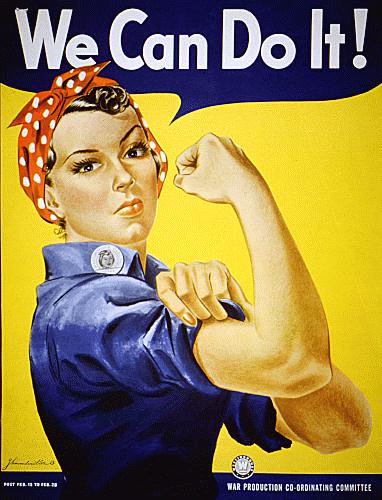
Propaganda


This propaganda works because the message is not overbearing. It is not scary, but empowering. It portrays strength and hope. The message is positive, and because of that and all of these other things, it will most likely stay in people's minds.

Wednesday, March 18, 2009

Literary Feature: Sentences

Variation (long/short), declarative, complex, compound, interrogative (rhetorical questions), use of participles, infinitives.

Analysis Notes and Observations: Atwood uses a lot of short sentences and some long ones: the use of the short sentences conveys a direct statement or fact and the use of the long sentences is when she is painting a picture for the reader. She also uses an excessive amout of description in some very long sentences to make the reader feel uncomfortable. Also, when Offred talks about the past, quotations are not used in the dialogue, which is most of the time. This creates a distance between the reader and the story and its characters.

An example of a short sentence that conveys a direct statement or fact is this situation, where Offred is describing the whispering between her and Ofglen. "It's more like a telegram, a verbal semaphore. Amputated speech" (Atwood 201). It seems as if most of the time, Offred states the facts and the story as it is. I do not remember many times throughout the book that she has stated her opinions about all of the events that occur, only her feelings, such as being scared or sad. This could be showing how her mind is restricted by this new society which thinks so little of women.

Significant Literary Questions:
  • Why is the author trying to create a distance by not using quotation marks in the dialogue?
  • Why does the author write in a way to make the reader feel uncomfortable?
  • What do the short sentences of direct facts reveal in the story?
  • Why does the author include an excessive amount of imagery in the story?

Thesis Statements: In Margaret Atwood's The Handmaid's Tale, the use of the short sentences of direct facts conveys how much the society has constricted the women's thoughts; however, the long sentences of their thoughts reveal how even though they are not thought to be very capable of anything but reproducing, they are much smarter than they are thought to be.

Although many might argue that The Handmaid's Tale by Margaret Atwood is not a very good book because it discusses uncomfortable topics such as the main one of human sexuality, it is in fact made this way to portray how women are treated in society, and how this needs to change and they need to be treated better and given more rights.

http://johntrinh.blogspot.com/

http://thanjrenglish.blogspot.com/

Dystopia Journal 2: Topic C

The author of The Handmaid's Tale, Margaret Atwood, is a feminist. This is seen in the book as the women in the society, the Republic of Gilead, are oppressed by the men. They are not allowed to work (except for household chores or work of that sort), unable to read or write, and are really only valued for their ovaries. However, Atwood makes the men look very stupid throughout the book. She makes them seem oblivious to the fact that all the women are against the society, and that most of them are disobeying so many of the rules. She portrays the women as being smarter than the men think they are. This shows her view of women. Atwood believes that women do outsmart men.
What makes this book so powerful and uncomfortable to read is how so much in the book relates to our lives as they are today. Offred's old life was what society today would consider a normal life. I think that this makes this possibility of the future even more believable because it is not a distant subject from the reader. It is in fact the reader's life that they are talking about. It is scary to think how much society could change. Especially here in the case of women's rights, which we have worked so hard for, to disappear in the blink of an eye.
In The Handmaid's Tale, Atwood really does not offer much hope. The one thing that seems to offer some kind of comfort is the fact that mostly all of the other women are on the same page. They mostly are all afraid and disagree with how the society has changed. There is comfort in knowing that they are not alone in such a strange and horrible society for women.

Word Count: 299

Wednesday, March 11, 2009

Dystopia Journal 1: Topic A

" 'I was coming to find you,' he says, breathes, almost into my ear. I want to reach up, taste his skin, he makes me hungry. His fingers move, feeling my arm under the nightgown sleeve, as if his hand won't listen to reason. It's so good, to be touched by someone, to be felt so greedily, to feel so greedy. Luke, you'd know, you'd understand. It's you here, in another body.
Bullshit" (Atwood 99).

This passage holds great significance in the book. Offred has disobeyed certain minor rules before, but never has she disobeyed such a major rule. The fact that she has disobeyed a major rule by messing around with another man besides the Commander shows her desire for passion, love, and to feel, not just touch. Throughout the entire book, she is not able to fulfill any of these desires. Offred and many other characters in the book crave to fulfill their wants and desires, but are left frightened seeing those who disobey the rules dead and hanging on the Wall. Offred's desire for love is especially seen here as she talks about her old husband, Luke. He has become a motif throughout the story as she reminisces about the old times. Here she feels the need to justify her actions with the man, which shows how her love for Luke still remains.
Another need which is seen in this passage is the need to feel valued or valuable. Offred says,"It's so good, to be touched by someone, to be felt so greedily, to feel so greedy". She feels as if she is worth something, which is showed in how she is "felt greedily". All the man wants is her, and she wants him. Here, she has the option to feel that way. It is in the darkness of the night that she is disobeying the rules.

Word Count: 245

Tuesday, March 3, 2009

Journal 9

What conclusion does Meursault come to at the end of the text? Does Camus want the reader to come to the same conclusion? Do you believe Meursault is happier or less happy at the end of the novel?
Meursault comes to the conclusion that he was happy with his life and he had come to terms with the fact that it was inevitable that he would die. I think that Camus wants the reader to realize a theme from Meursault's epiphany. However, I think he wants the reader to be frustrated with Meursault's inevitable death, therefore forcing the reader to come to a conclusion on why Camus would end the book that way. I think that Meursault is finally happy at the end of the book because he has come to terms with his life and realized that he has had a good life.

Monday, March 2, 2009

Stranger Thesis

Through his writing, Camus reveals the truth about society that many people live life standing still worshipping a higher power which may not even exist.

Sunday, March 1, 2009

Journal 8

Why does Camus create a part 1 and a part 2? Identify parallel ideas or scenes that occur between the two parts. What does Camus accomplish by comparing ideas between the two parts?
Camus creates a part 1 and a part 2 in order to show not only how Meursault has changed throughout the story, but surprisingly also how he has not. In part 1, Meursault really does not talk about being happy or unhappy, but realizes when he is in jail in part 2 just how happy he was with his life. This illuminates a theme of not knowing what you have until it's gone. However, in part one he doesn't really seem to care one way or another if he marries Marie. Then in part 2, he looks at her during his trial and says his heart doesn't feel a thing. It is interesting how Camus has used part 1 and part 2 to convey two totally different things.